
Arrest History in Monroe County
Monroe County Sheriff deputies make arrests in unincorporated areas and under law-enforcement contracts in Marathon and Islamorada. Key West Police creates its own city incident and arrest reports. Florida Highway Patrol, the Fish and Wildlife Conservation Commission, FDLE, and federal agencies can also arrest within the county. Regardless of the arresting agency, MCSO Corrections books county detainees at Stock Island, Marathon, or Plantation Key.
That shared booking role does not make every record a Sheriff police report. The originating agency keeps the event narrative and probable-cause material. MCSO keeps intake, custody, bond, and release data. The State Attorney decides whether to file charges, and the Monroe Clerk records the prosecution. Arrest history is therefore a chain of records, not one master county document.
Monroe Current Arrests First
The official MCSO Arrest Reports interface is the best first stop for a recent booking. The separate MCSO inmate search focuses on people in current or recent county custody. Use a booking identifier and date to separate similar names, and treat each listed charge as an intake allegation until a court disposition confirms the outcome.
A seven-day call log can add context through a CAD number, time, location, call type, and disposition. It is not an arrest list. A dispatched call may end without detention, while an arrest may stem from an older warrant rather than the event seen in the log.
How to Look Up Monroe County Arrests
Use every official layer that fits the event. Recent custody may appear before a prosecutor opens a case, and a released person may no longer be easy to find in a current roster. A focused report request fills the narrative gap. The Clerk and FDLE then answer broader questions about filed charges and Florida repository history.
- Search MCSO Current Arrests and the inmate tool. Save the booking number, arrest date, agency, and charge descriptors needed to distinguish the event.
- Identify the arresting agency. Ask MCSO Central Records for Sheriff, Marathon, or Islamorada reports; use Key West Police for a city arrest.
- Search the Monroe Clerk after filing. Match the name, date, and charges, then read each count's disposition rather than assuming the booking charge remained.
- Use the Florida Department of Law Enforcement CCH portal for public statewide history, or the free fingerprint Personal Review for one's own record.
- If the web tools fail, make a narrow public-record request with incident number, date, time, location, record type, and preferred delivery method. Phone 305-292-7050 for MCSO Central Records.
Who Holds Monroe Arrest Reports
The arresting agency decides where the police report lives. MCSO Central Records at 5525 College Road in Key West handles Sheriff-created records and can be reached at 305-292-7050. The Roth Building in Tavernier serves Upper Keys records at 305-853-3211. Key West Police records are at 1604 N. Roosevelt Boulevard, 305-809-1111, with email at kwpdrecords@cityofkeywest-fl.gov.
Florida Public Records Law does not require a reason for a request or make writing mandatory, though a written scope is useful. Give the incident or CAD number if known, a date range, location, agency unit, and desired record. Active investigative facts, juvenile material, protected victim information, and confidential identifiers may be withheld or redacted. The county's BOCC portal is not the custodian for police reports.
MCSO Central Records
5525 College Road
Key West, FL 33040
305-292-7050
Call before an in-person visit.
What a Monroe County Arrest Record Shows
A public arrest or booking entry commonly identifies the agency, report or CAD number, event and arrest dates, statutory and narrative allegations, booking number, facility, bond or hold, first appearance, release status, and basic descriptors subject to redaction. The full police report may add the alleged facts, officer narrative, property inventory, and warrant or warrantless basis. Public access varies by field.
| Booking Number | Links the person to one MCSO intake event and helps separate similar names. |
|---|---|
| Booking Date & Time | Shows when Corrections accepted custody, not when guilt was determined. |
| Arresting Agency | Identifies who holds the incident or probable-cause report. |
| Charges | Lists allegations recorded at intake, which may differ from later filed counts. |
| Bond | Shows a listed amount or hold when public; release conditions may change in court. |
| Booking Photo | Documents custody and identity at intake; it is not proof of guilt and is not republished here. |
| Release Status | May show release information or current facility status when available. |
Monroe Bookings Reach FDLE
At intake, fingerprints and a transaction control number identify a qualifying arrest cycle sent into Florida's Computerized Criminal History system. Later, court dispositions should flow back so FDLE can connect the arrest with the result. Agency lag, older records, unmatched identifiers, or a missing final report can leave the statewide summary incomplete.
The FDLE Instant Florida Criminal History Search is a paid public name search. It costs $24 plus a $1 card processing fee and normally produces an immediate noncertified result. Name similarity is not fingerprint identification.
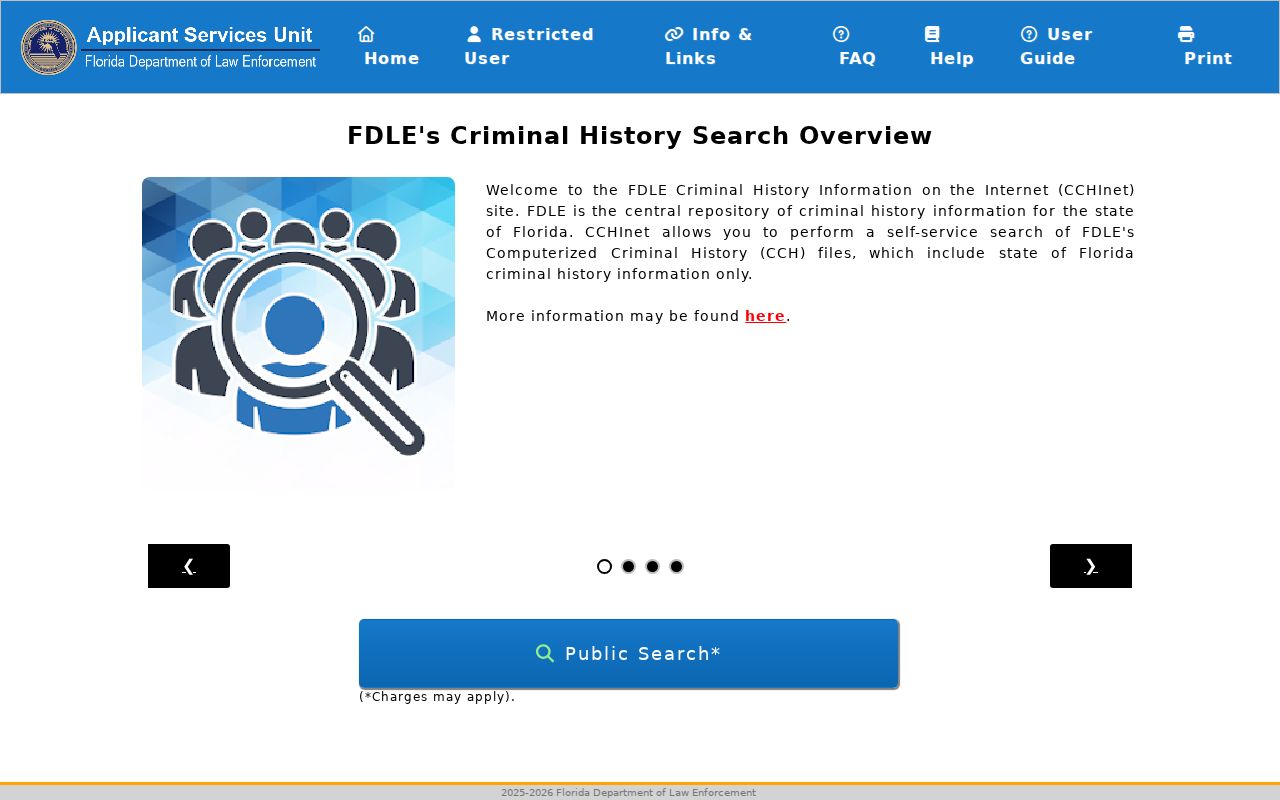
The captured FDLE portal is the statewide repository layer, not a replacement for the MCSO booking or Monroe Clerk case file.
Recent Arrests and Booking Logs
MCSO's Current Arrests interface is a recent-booking route, while its inmate tool focuses on county custody across three facilities. Stock Island's main Monroe County Detention Center serves the Lower Keys and can house prisoners from throughout the county. Marathon and Plantation Key provide branch detention in the Middle and Upper Keys. Corrections books people arrested by every local law-enforcement agency.
Recent and current are not lifetime terms. A person may leave the roster after release or transfer, and an allegation may later be changed, declined, dismissed, or resolved. For transfer to state prison or felony supervision, use the FDC Offender Search. Federal custody belongs in the federal locator. Call MCSO at 305-289-2351 or 305-292-7000 when custody status needs confirmation.
Note: No result in a current Monroe County jail tool proves neither that an arrest never happened nor that a case ended.
Monroe Arrest Charges Can Change
The officer records arrest allegations based on the facts known at that stage. The State Attorney then reviews the matter and may file different counts, decline prosecution, or proceed through an information or indictment. The Clerk docket records those filed counts. This is why matching only the charge label can mislead.
Use the person's identifiers, arrest date, booking number, and agency to find the likely prosecution. Then read every count and disposition in the Monroe County criminal court case records. A dismissal in court does not automatically erase the earlier agency or repository arrest entry. Florida sealing or expunction requires a separate statutory process and court order when the person is eligible.
Arrests vs Convictions
An arrest record proves that a custody event was recorded. It does not prove that prosecutors filed the same charge or that a court found guilt. A conviction comes from the court process and appears in the judgment and disposition. MCSO, the arresting agency, the Monroe Clerk, and FDLE can therefore hold related records with different scopes and update times.
| Arrest Record | Conviction Record |
|---|---|
| Created by the arresting agency and MCSO booking staff. | Created through the Circuit or County Court case. |
| Shows an arrest and intake occurred. | Shows a court adjudication or other qualifying judgment. |
| Lives with the agency, jail system, and reported FDLE cycle. | Lives in the Clerk file and may be reported to FDLE. |
| May be followed by release, no filing, dismissal, or later expunction. | May lead to sentence, appeal, supervision, sealing, or other post-judgment action. |
Note: An arrest is not proof of guilt; verify the final Monroe County court disposition before relying on a booking allegation.
Correct Your Monroe Arrest History
A person reviewing their own Florida record can use FDLE's free fingerprint-based Personal Review under section 943.056. Fingerprints must be taken by a law-enforcement or criminal-justice agency and mailed with FDLE's form. The result is for self-review, is not certified, and gives a route to challenge incomplete or inaccurate repository information.
The FDLE Personal Review instructions explain the fingerprint and mailing process.
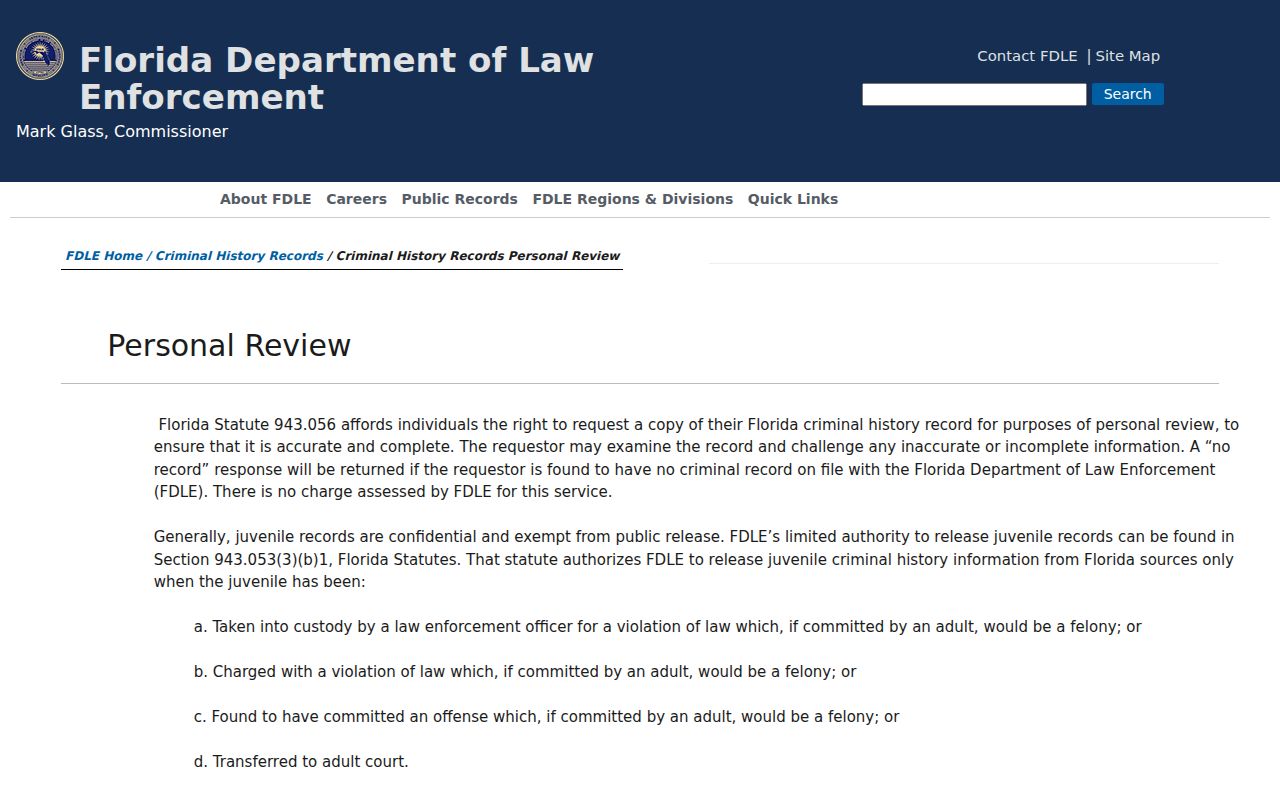
This official self-review channel can resolve identity and disposition issues that a public name match cannot.