
How to Check Criminal History in Monroe County
Begin with the record that answers the question. The Monroe Clerk criminal search shows county court cases filed from 1990 forward, while the Sheriff's official arrest reports and inmate tools cover bookings and custody. FDLE's statewide history product reaches public Florida repository data. These sources overlap, but none replaces the others.
Before searching, collect a full name, date of birth if known, spelling variants, and an approximate event date. A common name may return unrelated cases. Fingerprints, not a name match, establish identity. Write down case numbers and booking identifiers because they lead to more reliable detail than repeating a broad name query.
- Choose the Clerk for filed cases, MCSO for booking or custody, or FDLE for statewide public history.
- Enter a name, case number, citation, date range, or location code supported by that portal.
- Compare dates, birth information, agency, and location before treating a result as a match.
- Open the docket, booking entry, or repository result and check the current status and disposition.
- Request a certified Clerk copy or official FDLE product when an informal screen is not enough.
Search Monroe County Criminal Cases From 1990
The Clerk portal accepts several routes into the same Monroe County criminal docket. Its criminal category covers felony, misdemeanor, criminal traffic, ordinance, and related cases. Public users can search without an account, but the site limits a query to 500 results. Narrow dates or add a case type when a common surname produces too much.
| Search route | Useful input | Best use |
|---|---|---|
| Name | Last, first, middle, party type | Finding possible cases when no number is known |
| Case number | Year, sequence, case type, location suffix | Opening one known Monroe docket |
| Citation | Citation or uniform traffic number | Criminal traffic and citation-linked matters |
| Date range | Filed-from and filed-to dates | Reducing a large result list |
| Location | Key West, Marathon, or Plantation Key code | Routing a case to the proper Keys branch |
A docket may show events while withholding an image under Florida electronic-access rules. For a missing document, older file, certified copy, or broad historical search, contact a Clerk criminal counter instead of assuming the record does not exist.
Official Florida Background Checks
The Florida Department of Law Enforcement Division of Criminal Justice Information Services is the central state repository. Any member of the public may order a name-based search through the FDLE Instant Florida Criminal History Search. The noncertified instant product is normally available at once and can be printed or emailed.
A name search can confuse people with similar identifiers. For a free review of your own Florida record under §943.056, obtain fingerprints from a law-enforcement or criminal-justice agency and mail them with FDLE's Personal Review form. Statutorily authorized state-and-national checks use a registered Livescan provider and the ORI supplied by the requesting agency.
| FDLE product | Charge | Typical processing |
|---|---|---|
| Instant noncertified name search | $24 plus $1 card processing | Normally immediate |
| Staff-processed noncertified result | $24 | Five business days, excluding mail |
| Staff-processed certified result | $24 | Six to seven business days, excluding mail |
| Fingerprint personal review | Free from FDLE | Mail process; fingerprinting terms vary |
Three Monroe County Criminal Records Counters
Monroe County's courthouse geography follows the Florida Keys for more than 100 miles. Lower Keys records are served at 500 Whitehead Street in Key West. The felony line is 305-295-3963 and the misdemeanor line is 305-292-3545. Public hours are Monday through Friday, 8:30 a.m. to 5 p.m.
Key West Criminal Counter
500 Whitehead Street, Key West, FL 33040. Circuit and County Court criminal files for the Lower Keys.
Marathon Branch Courthouse
3117 Overseas Highway, Marathon, FL 33050. Phone 305-289-6027 for Middle Keys service.
Plantation Key Branch
88770 Overseas Highway, Suite 2, Tavernier, FL 33070. Phone 305-852-7145 for Upper Keys service.
The Upper Keys Government Center is also identified as 88820 Overseas Highway. That difference reflects the building address versus the Clerk's suite and mailing address. Use the address printed on the specific Clerk form or current contact page.
Types of Criminal Records
A Monroe County criminal history is assembled from records created at different stages. Police and deputies create incident and arrest reports. MCSO creates the booking and custody entry. The State Attorney makes filing decisions, the Clerk opens the court docket, and FDLE receives qualifying arrest fingerprints and later disposition information.
The record holder matters because each source has a different scope. A booking can remain even if no charge is filed. A court dismissal does not automatically erase an arrest cycle. A prison locator does not show every county jail stay, and a registry profile is not a general rap sheet.
- Arrest and booking records show the agency action and entry into Monroe County custody.
- Criminal court case files follow charges, hearings, pleas, motions, disposition, and sentence.
- State criminal-history entries connect reported Florida arrest cycles with dispositions received by FDLE.
- Warrants may appear through MCSO, FDLE, and court docket events but require agency confirmation.
- Supervision and registry records come from FDC, local probation channels, or FDLE's public registry.
Monroe County Sheriff Records and Custody
The Monroe County Sheriff's Office is the source for Sheriff incident reports, arrest reports, jail bookings, inmate status, and official warrant pages. Central Records is reachable at 305-292-7050 in Key West and 305-853-3211 in Tavernier. Marathon and Islamorada contract with MCSO, so their police reports are Sheriff records rather than City Clerk records.
The arrest interface can be searched by booking date and related public fields. The inmate tool answers current county custody questions. Those tools should not be read as conviction lists. An arrest allegation is not proof of guilt, and the Clerk docket is the place to follow a filed case toward its disposition.
The official MCSO mobile app is documented for iOS and Android. It provides Sheriff information and tools on a phone, but it does not change the source of the underlying record. Confirm any warrant through the issuing agency and never attempt an apprehension.
What a Monroe County Criminal Record Shows
The fields depend on whether the reader opened an arrest report, Clerk docket, or FDLE result. A court case generally provides the clearest account of the judicial outcome. Read names and dates with case numbers, statutes, event text, and disposition rather than pulling one line out of context.
| Name & Identifiers | Filed name, aliases or spelling variants, birth information where public, and agency or case identifiers. |
|---|---|
| Arrest / Booking Data | Arresting agency, date, booking number, facility, allegations, bond, hold, and release fields as public. |
| Charges & Statutes | Filed counts, degree, Florida statute, description, and amended or dismissed charges. |
| Disposition | Plea, verdict, dismissal, adjudication, or other final court action. |
| Sentence | Jail or prison term, credit, fine, costs, probation, community control, and conditions when public. |
| Custody / Supervision Status | County custody through MCSO or prison and felony supervision through Florida Department of Corrections. |
How Monroe County Criminal Records Reach FDLE
An arresting agency first creates its report. When a qualifying arrest is booked, fingerprints and a transaction control number identify the arrest cycle transmitted to Florida's Computerized Criminal History system. MCSO separately maintains the county booking and custody record. The State Attorney then decides which charges, if any, to file, and the Clerk creates the court docket.
Pleas, dismissals, judgments, and sentences should return to FDLE so the state history connects the arrest with its result. Lag, an unmatched identifier, an older file, or a missing disposition may create a gap. Compare the Clerk and FDLE results, then use the free fingerprint personal review to challenge your own incomplete or inaccurate state record.
Public Access Laws
Florida starts from a broad right of access, but it does not make every criminal record or every field public. Juvenile matters, sealed and expunged files, protected-victim information, confidential identifiers, active investigative material, and records restricted by court rule may be withheld. Ask the proper custodian for the record rather than sending one request to county administration for everything.
Key Statutes:
Florida Statutes Chapter 119 - establishes the Public Records Law and agency access duties.
Florida Statutes §943.053 - governs dissemination of criminal-history information held by FDLE.
Florida Statutes §943.056 - gives a person a route to review and challenge their own state record.
Florida Statutes §943.0585 - sets the court-ordered expunction framework.
Florida Statutes §943.059 - sets the court-ordered sealing framework.
Route Monroe County Public Records Correctly
The Monroe County public-records page makes a useful distinction: court files go to the Clerk, while police reports go to the Sheriff or the police agency that created them.
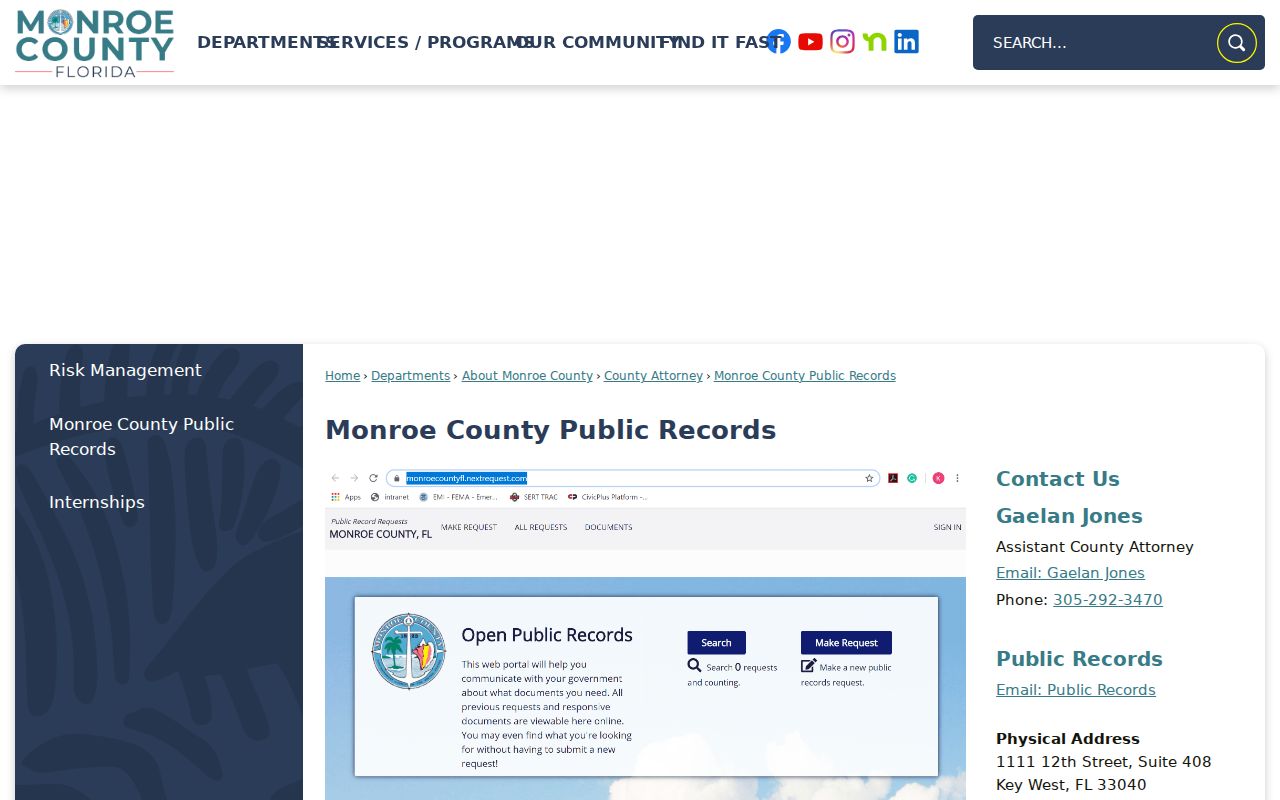
This routing keeps a request from sitting with an office that never held the document. County administrative records are a third category and may remain with the relevant county department.
The official Monroe County government site supplies the department directory and county contact layer.
Use that directory for county administration, but continue to the Clerk or law-enforcement custodian for criminal records. Florida requests generally need a clear description of the desired record, not an explanation of why it is wanted.
Sealed, Expunged & Restricted
Florida uses both sealing and expunction. FDLE first decides eligibility for a certificate; the person then petitions the court that handled the case. A disappearance from a public search is not proof that every agency record has been destroyed, and a dismissal alone does not automatically seal or expunge the linked arrest.
Juvenile files and protected-victim information have separate access limits. Sealed material can remain available to agencies or entities named by law even when the general public cannot retrieve it. Anyone checking their own Monroe County record should compare the current Clerk docket with FDLE's fingerprint review and follow the statutory correction or relief process rather than relying on a blank web result.
Confirm Monroe County Criminal Warrants Through Four Channels
MCSO publishes official alphabetic active-warrant pages, and FDLE operates a statewide Wanted Persons Search. A Monroe Clerk docket may also show a capias or bench-warrant event. None of those screens should be the final word when safety, surrender instructions, or a court appearance depends on current status. Call the originating agency or issuing court and confirm the warrant directly.
The Clerk explains that a missed court date can produce a Bench Warrant and Order of Bond Estreature. Clerk staff cannot recall, set aside, or reinstate the warrant because only the court can do that. A person resolving their own warrant should contact the issuing court or counsel, verify bond or surrender instructions, and avoid assuming that an absent web result means the warrant has cleared.
| Channel | What it adds | Caution |
|---|---|---|
| MCSO warrant pages | Official Monroe Sheriff warrant listings | Never approach or attempt to detain anyone |
| FDLE Wanted Persons | Statewide wanted-person search | Confirm with the originating agency |
| Monroe Clerk docket | Capias, bench-warrant, bond, and hearing events | Some warrants and juvenile matters are not public |
| Issuing court or agency | Current confirmation and instructions | Use the case or warrant number when available |
Monroe County Criminal Sentencing Records Beyond the Jail
MCSO answers county custody questions, while Florida Department of Corrections covers state prison and felony community supervision. The FDC Offender Search can be filtered for incarcerated or supervised populations. It should be read beside the Monroe sentencing docket because the court file explains the judgment that produced custody or supervision.
The Florida Department of Corrections homepage leads to statewide corrections and community-supervision services.
County-court probation is not identical to FDC felony supervision, and pretrial release is not probation. Check the sentencing docket and the correct supervising office before interpreting a status.
Monroe County Criminal Case Records Separate Pretrial From Probation
Sixteenth Circuit Pretrial Services screens people after arrest, provides first-appearance and release information, and supervises court-ordered conditions while a case remains pending. It is not a conviction record and does not mean a person is serving probation. Conditions can include check-ins, court attendance, travel notice, testing, treatment, no-contact terms, or electronic monitoring.
The Sixteenth Circuit Pretrial Services page provides its forms, contacts, and program description.
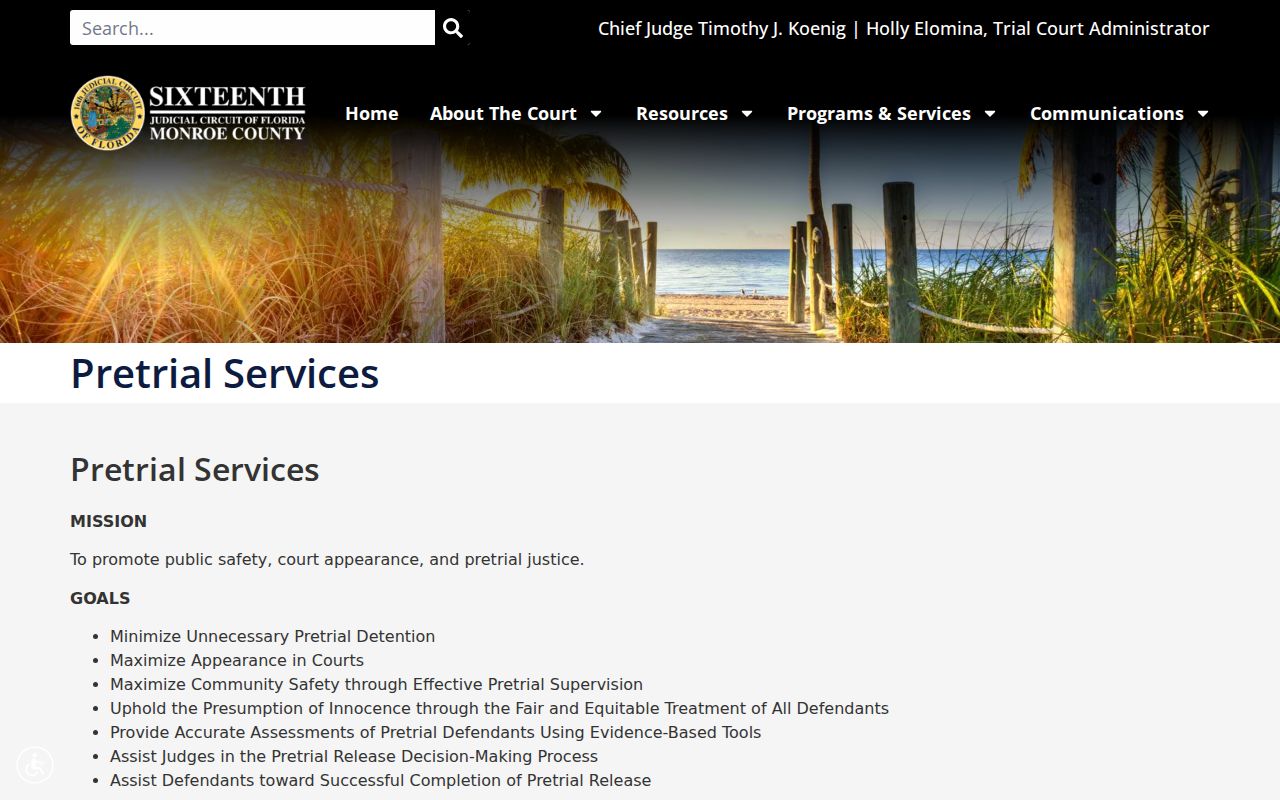
A violation may generate a filing or warrant event, but the Clerk docket and issuing court provide the authoritative case action. Keep pending release supervision separate from a later sentence.
Choosing a Monroe County Criminal History Product
FDLE distinguishes an instant name search, staff-processed certified and noncertified products, a free fingerprint personal review, and ORI-based checks authorized by statute. The official Florida Checks page explains those routes and their current terms.
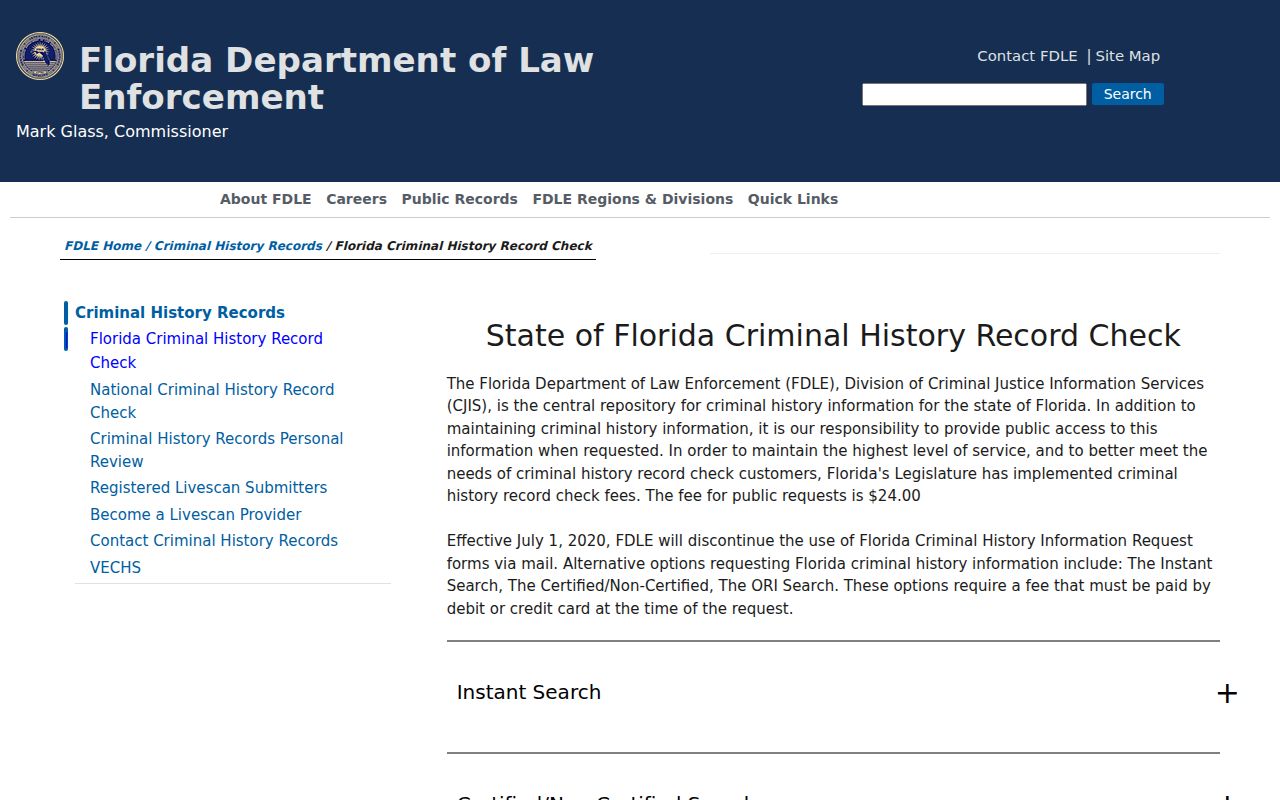
For personal review and correction, use the fingerprint route. For a quick public name query, use CCH with care about similar names. Court-certified copies still come from the Monroe Clerk rather than FDLE.
- Arrest cycle
- The fingerprint-linked state transaction created from a qualifying booking.
- Docket
- The Clerk's chronological court record of filings, hearings, and outcomes.
- Disposition
- The court result for a charge, such as dismissal, plea, or verdict.
- Certified copy
- A copy authenticated by the official custodian, commonly the Clerk for court records.
Criminal Records by City in Monroe County
Key West operates its own police department, while Marathon and Islamorada contract with the Monroe County Sheriff's Office. All three route criminal, ordinance, and traffic court files into Monroe courts rather than separate municipal court databases. The city guides preserve the correct police-report custodian and nearest Clerk counter.
Key West Criminal History
Key West Police records · Court files at the Whitehead Street Clerk counter
Marathon Criminal History
MCSO District service · Middle Keys court files at the Marathon branch
Islamorada Criminal History
MCSO District 6 records · Plantation Key court and custody channels