
How to Check Criminal History in Marathon
Start with the office that created the record. Marathon contracts with MCSO for law enforcement, while the City Clerk keeps city business records. Arrests enter county custody, and filed cases go to the Monroe Clerk's Marathon branch. Florida's state repository is a later, broader layer. This order avoids sending a police-report request to City Hall or treating a county booking allegation as a court outcome.
- Check the MCSO seven-day call log for recent Marathon activity, but do not treat a call as proof of arrest.
- Search MCSO Current Arrests or county inmate records for a booking, then request the report from MCSO Central Records.
- Search the Monroe Clerk criminal docket for filed counts, using the M or AM suffix when a case number is known.
- Ask the Marathon Clerk counter for an older image, copy, certification, or help locating a county court file.
- Use FDLE for statewide Florida history or fingerprint-based review of one's own record.
Marathon Uses Sheriff Policing
Marathon has no city police department. Its fiscal 2024 through 2027 agreement assigns law enforcement to the Monroe County Sheriff's Office. The district model includes a captain, lieutenant, four sergeants, twelve deputies, a near-shore patrol officer, and a crossing guard, with road patrol around the clock. Those staffing terms explain why Marathon incidents appear in MCSO systems rather than a stand-alone city police portal.
The local substation is at 3103 Overseas Highway, 305-289-2430. County nonemergency service is 305-289-2351. For a report, identify the date, place, CAD or incident number, and type of record. Emergency channels are for current threats, not records research.
The Marathon Police Department
The title can cause confusion because Marathon does not operate a municipal police department. MCSO deputies are the city's police service under contract. They create incident, offense, arrest, and related law-enforcement records for Marathon calls. MCSO Central Records, not the Marathon City Clerk, handles those police files.
Central Records is at Sheriff headquarters, 5525 College Road in Key West, 305-292-7050; Upper Keys records use 305-853-3211. The Marathon substation can help route a local question, but callers should confirm where a copy request or inspection will be processed before traveling. Active investigative facts, juvenile information, protected victim data, and confidential identifiers may be withheld under Florida law.
Marathon City Records Stay Separate
City Hall keeps municipal administrative records, not Sheriff police reports. Marathon's public-record form covers city files and says use of the form is not mandatory. It asks for contact name, email, phone, optional fax, a description, and whether copies are wanted. Building-record requests can add real-estate number, lot, block, subdivision, owner, business, location, and permit or work type.
The custodian is at 9805 Overseas Highway, 305-289-5020; the City Clerk line is 305-289-4130 and email is cityclerk@ci.marathon.fl.us. Weekday hours are 8 a.m. to 5 p.m. Extensive clerical, information-technology, or supervisory work may lead to an estimate or deposit. That applies to city records, not as a universal price for MCSO or court copies.
The official City of Marathon source identifies the municipal custodian and local government channel.
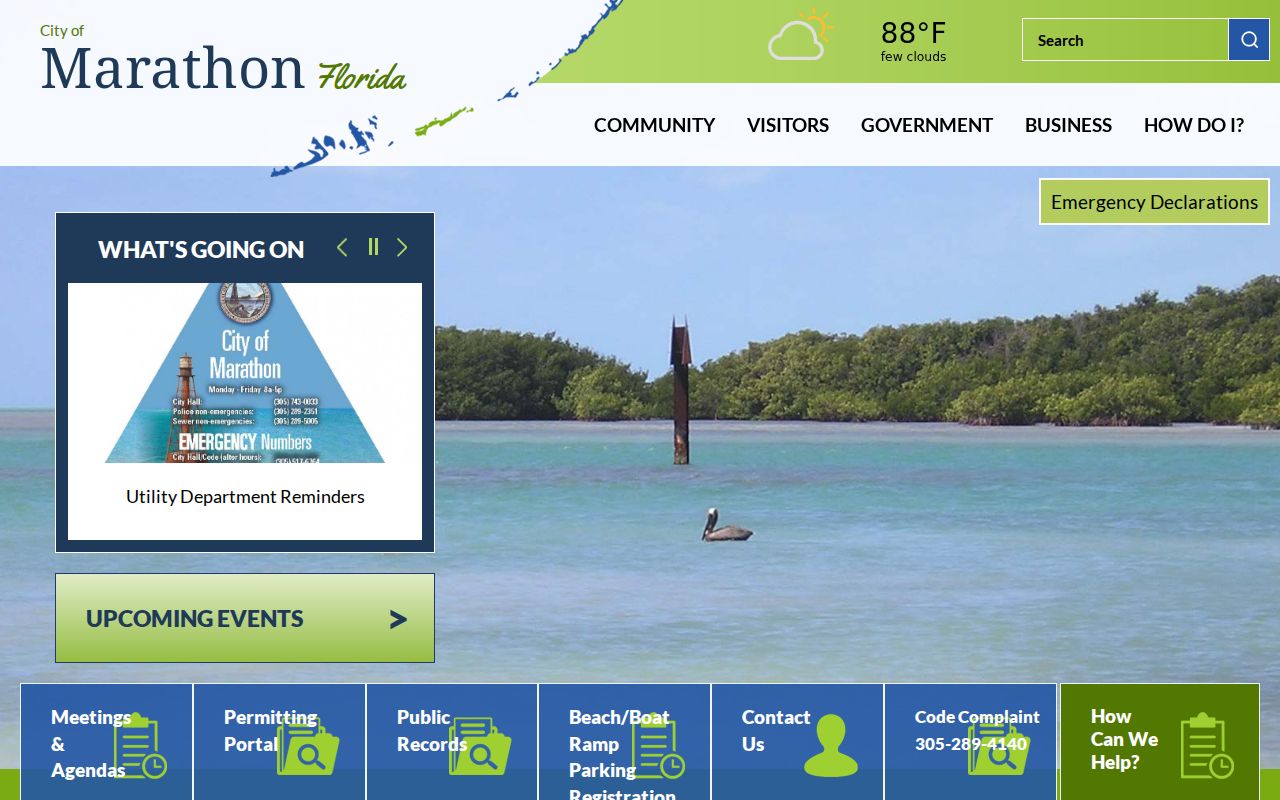
The city source is useful for administrative files while law-enforcement requests remain with MCSO.
Arrests and Bookings in Marathon
MCSO Corrections books people arrested in Marathon. The local detention branch is at 3981 Ocean Terrace, but MCSO operates one county custody system across Marathon, Plantation Key, and the main Stock Island jail. Current Arrests is the better path for a recent intake, while inmate search focuses on current or recent custody.
A booking may appear before prosecutors file a case. Save the booking number, arrest date, agency, and allegation, then check the Clerk docket later for the filed counts and disposition. A released or transferred person may no longer appear in a current roster. For a deeper treatment of that record chain, use the county Monroe County arrest history page.
Read Marathon Sheriff Call Logs
MCSO's seven-day log can provide a CAD or call number, date, time, general location, event nature, and disposition or status. Some addresses are withheld. Filter or scan for Marathon labels, then use the call number when asking about a public incident report. The log is a short window into dispatch activity, not a permanent criminal-history index.
A call row does not prove that police made an arrest. It may reflect a service request, alarm, traffic event, welfare check, or a call resolved without enforcement. Conversely, a Marathon arrest on a warrant can stem from a prior case rather than a fresh logged event. Match the log to an official report, booking, or docket before drawing a conclusion.
Marathon Municipal Court Records
No separate Marathon municipal court was found in the official sources. City-related criminal, traffic, and ordinance files use Monroe County Court or Circuit Court as the case requires. The Marathon Branch Courthouse at 3117 Overseas Highway, 305-289-6027, is the local records counter. Its M and AM location codes help identify Middle Keys files.
| Court Name | Monroe County Court for lower-level cases; Sixteenth Judicial Circuit for felonies. |
|---|---|
| Case Types Heard | Misdemeanor, criminal traffic, ordinance, and felony matters according to court level. |
| Case Lookup Channel | Monroe Clerk online criminal search or Marathon branch counter. |
| What the Docket Shows | Case number, parties, counts, events, hearings, dispositions, sentence, financial data, and allowed images. |
| Copies & Fees | Monroe-only letter $2 per year searched, $1 per copied page, and $2 per certified document. |
Marathon Court Codes M and AM
Monroe case numbers encode location. M and AM point to Marathon, while K and AK identify Key West and P and AP identify Plantation Key. A full case number follows the Clerk's year, case type, sequence, and location pattern. Enter the sequence without leading zeroes when the portal calls for that format.
A name search requires both first and last name. Date searches require a start and end date, and the public portal limits results to 500. Narrow broad Marathon searches by case type, middle name, date, or exact number. Docket data generally reaches back to about 1990, while most document images begin around 2007, so a missing image does not mean the case is absent.
Where Marathon Records End Up
A Marathon event begins with an MCSO report because the Sheriff provides city policing. Corrections adds the county booking. The State Attorney decides what to file, and the Monroe Clerk creates the case docket. Fingerprint-supported arrest cycles and reported court outcomes can then reach FDLE's statewide repository.
Record flow: MCSO Marathon District › Monroe County Courts › Florida Department of Law Enforcement
Use the first layer for the incident narrative, county custody tools for booking, and the docket for the legal outcome. FDLE is broader than Marathon but may lag or lack a matched disposition. A fingerprint comparison, not a similar name, is the sound identity method.
Marathon MCSO Mobile Access
The official MCSO app gives residents another route into Sheriff information. Features can change with app versions, so use it as a gateway and confirm a record with the office that owns it. It does not turn a dispatch entry into an arrest or replace the Monroe Clerk docket for a filed case.
The official MCSO Android listing is the documented store source for Marathon's contracted law-enforcement agency.
The app connection reflects Marathon's Sheriff district model, not a separate city police system.
Marathon Records Across Mile Markers
Marathon incorporated in 1999 and spans mile markers 47 through 60 across several islands. Its name is tied to Florida East Coast Railway workers calling the difficult project a “real Marathon.” Today, the nearby Sheriff substation, detention branch, and Clerk counter reduce trips through the long Keys corridor.
That geography shapes access but does not create city-only court or jail systems. MCSO's county-jurisdiction crime totals are not Marathon-only statistics. Do not convert county agency data into a city risk claim. For a specific event, use the report, booking, and court record tied to that event.
The same local layout helps when a web search is incomplete. A resident can begin with the Marathon substation for routing, use the Ocean Terrace custody location for operational questions, and take a court-copy issue to the Overseas Highway Clerk branch. These offices sit close to the city they serve, but their records still belong to separate county custodians. Keep the incident number, booking number, and court case number apart. Each identifier opens a different part of the Marathon record chain.
Public Access Rules for Marathon Records
Florida's constitutional access right and Chapter 119 apply to nonexempt agency records, but each custodian answers for its own files. Marathon City Hall handles municipal administration, MCSO handles Sheriff police reports, and the Clerk handles judicial records under court-access rules. A requester need not explain a purpose, and an agency need not create a new record or custom answer.
Key Statutes:
Florida Public Records Law requires access to nonexempt agency records and permits lawful redaction and cost recovery.
Florida Statutes section 943.053 governs dissemination of state criminal-history information through FDLE.
Florida Statutes section 943.056 provides a fingerprint-based personal review and challenge route.
Juvenile material, active criminal investigative information, protected victim facts, sealed or expunged cases, and confidential identifiers may not appear in public results. Ask the right custodian to state the legal basis for any withheld part.